
Category Archives: San Diego Bay Fly Fishing

Why would you make a sport that’s already difficult, more difficult by trying to do it in a kayak?

“Why would you make a sport that’s already difficult, more difficult by trying to do it in a kayak?”

That was said to me years ago when I first bought a kayak for fly fishing.  I laughed then and it’s still funny now because to a certain extent it’s true.

I love fishing in a float tube. I have over 35 years of experience fishing in a float tube. I “cut my teeth” fly fishing in a float tube in Lake Crowley. A float tube gives you so much more access to water you couldn’t fish by wading.  Having access to a float tube gives you access to fly fishing our bays and our lakes here in SoCal where I live.

It was San Diego Fly Fishers Club (SDFF) members John Ashley and Kai Schumann who convinced me I needed to buy a kayak for fly fishing. I desperately wanted to go on the club’s annual camping and fly fishing Baja trip. “You can’t fish the mangroves in the Estero in Baja without a kayak.”, they said. Although at the time I was skeptical, purchasing a kayak was one of the best, if not the best, fly fishing decisions I’ve ever made.
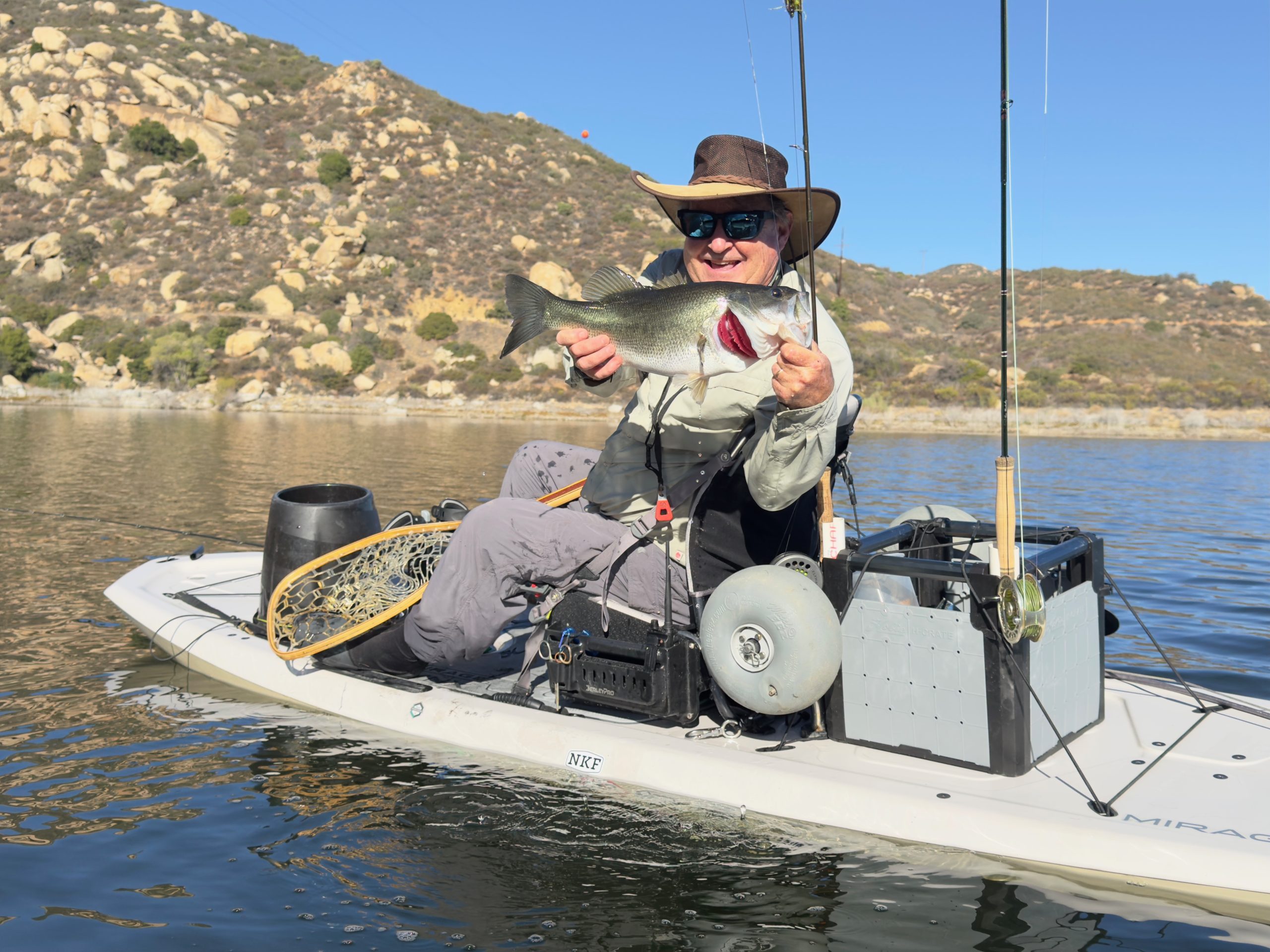
me

It’s the simple fact, that my kayak gives me so much more access and 10X the range of a float tube. A kayak is lightning compared to a float tube.  When it’s calm, I even take my kayak into the open ocean. I can even chase the boils, whether it be the shad in Lake Barrett or in the salt water, and be a lot more agile than a motorized boat. There’s no way you could chase down fish boiling on a float tube. I’ve chased the large mouths tormenting the shad bait balls in Lake Barrett. I’ve chased the white sea bass tormenting the sardines in Agua Hedionda in Carlsbad.

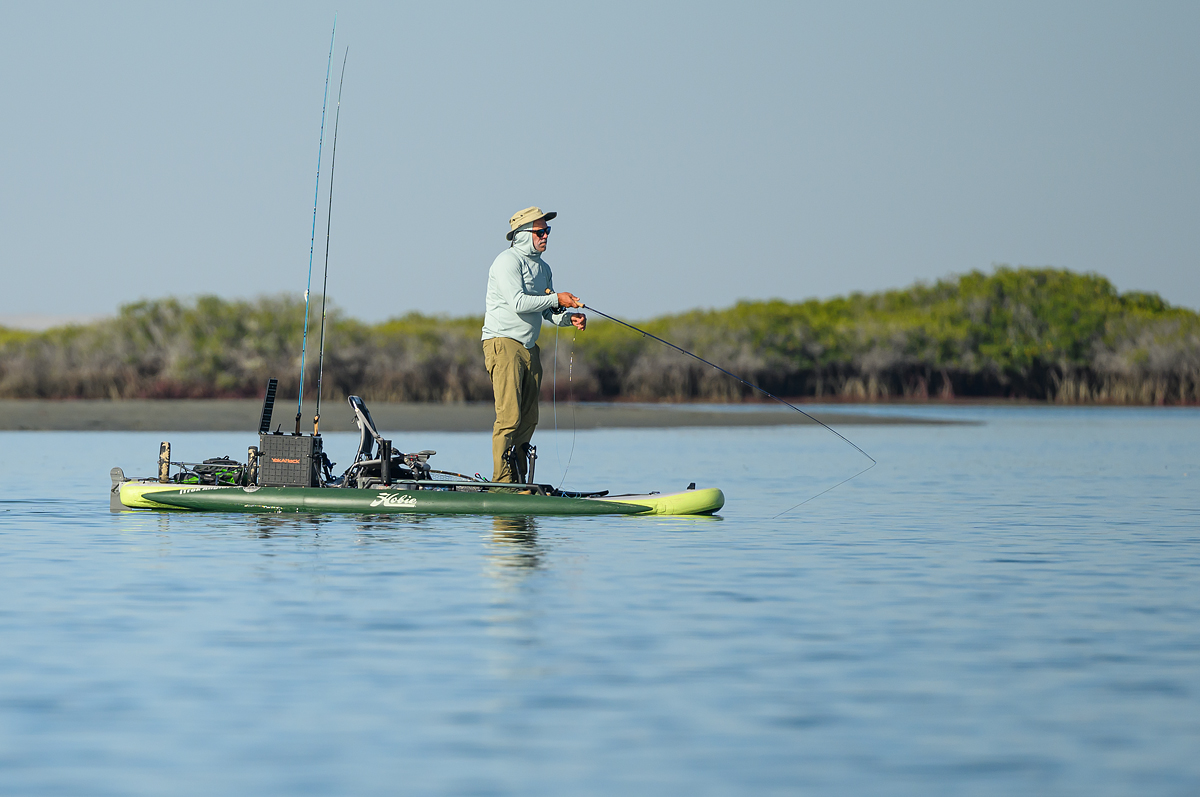
When you think of a kayak, you typically think of paddling with a two bladed oar. That’s not the case with the kayaks we use in the San Diego Fly Fishers Club. The typical kayak of the San Diego Fly Fishers Club is a Hobie Kayak with Mirage Drive. Hobie Mirage Drive give you pedals attached to fins that propels the kayak, allowing you to fly fish “hands-free”.  Certain models of the Hobie Mirage Drives we use in the club have forward and reverse and can practically “turn on a dime”.  Having reverse and that type of agility is practically necessary for club trips like in the narrow canals of Squaw Lake. And in the mangroves of Estero Coyote in Baja.
A Float Tube pretty much demands that you wear waders and fins. And because of sitting in the water, even though you’re dry, you’re just going to be a lot colder than sitting on top of a kayak. Frequently I can step on my kayak, fish all day then off my kayak, and not even get wet.

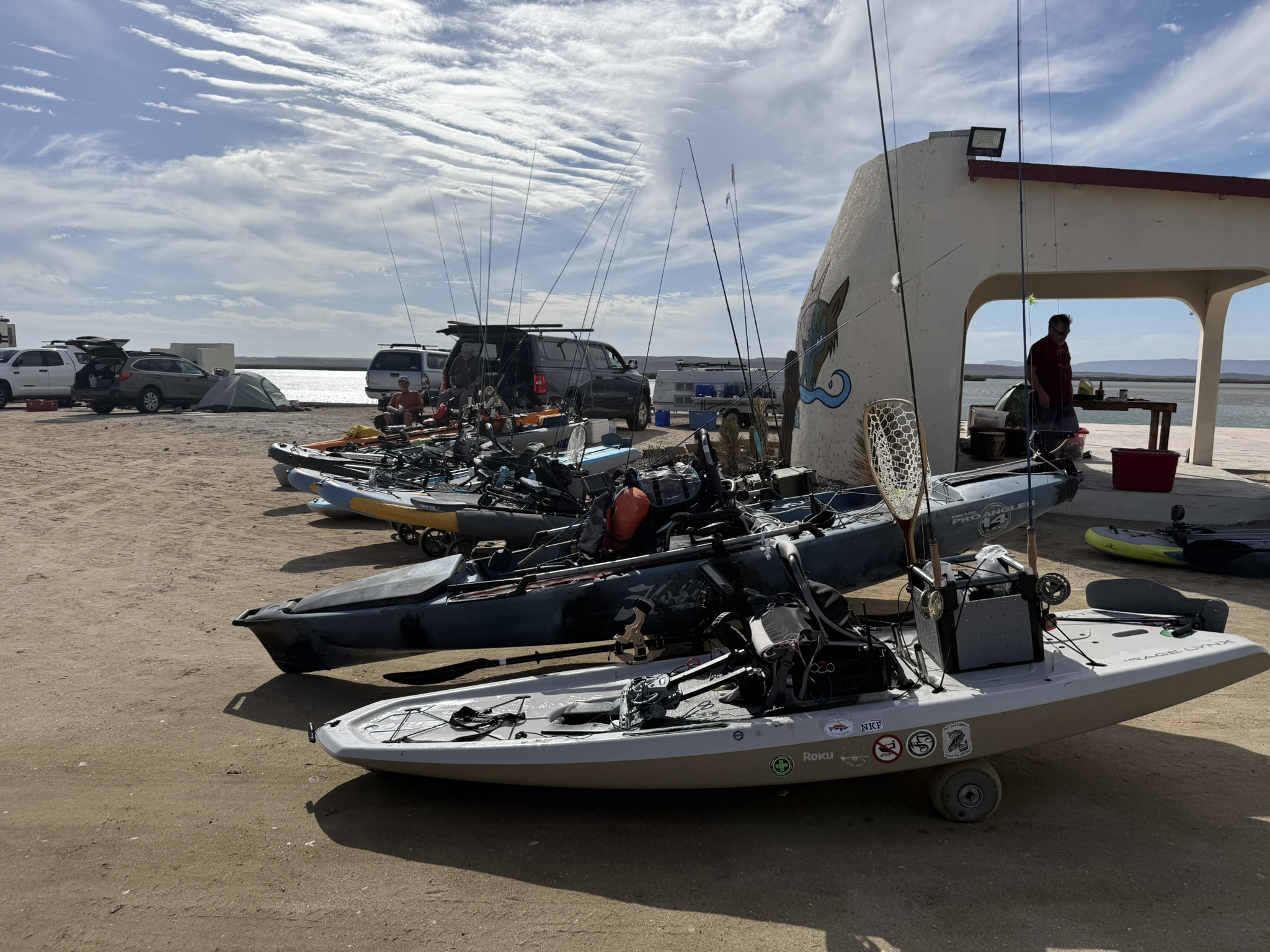
In the SDFF club most people use one of three types of Hobie Mirage kayaks:

  • The I-Trek series: I’d say the majority of SDFF club members own an I-Trek because they are an inflatable. Being inflatable makes easily portable, just like a float tube is. It packs up into a ridiculously small footprint so it’s easy to throw in the back of your car. The drawback, of course, is as an inflatable, if you run into something sharp, you’re going to get a puncture. The punctures are easily fixed but it’s a hassle, nonetheless.
  • The Lynx: there’s about a dozen of us in the club that own this model and I’m one of them. I love my Lynx. It’s my pride and joy. My fly fishing life improved so dramatically when I got my Lynx. Unrigged it weighs less than 50 lbs so it’s easy for me to slide it on top of racks on my truck. It’s made of the same materials a stand-up paddle board is made from. It’s lightning quick and stable. I can stand up and walk from bow to stern on it. Its drawback is that because it’s light, it gets blown around pretty good in the wind.
  • The Pro Angler: The gold standard for pedal‑driven fishing kayaks. Suitable for the open ocean. The Pro Angler is big and heavy; rugged and durable. A trailer is recommended but you can roof rack them with some effort.
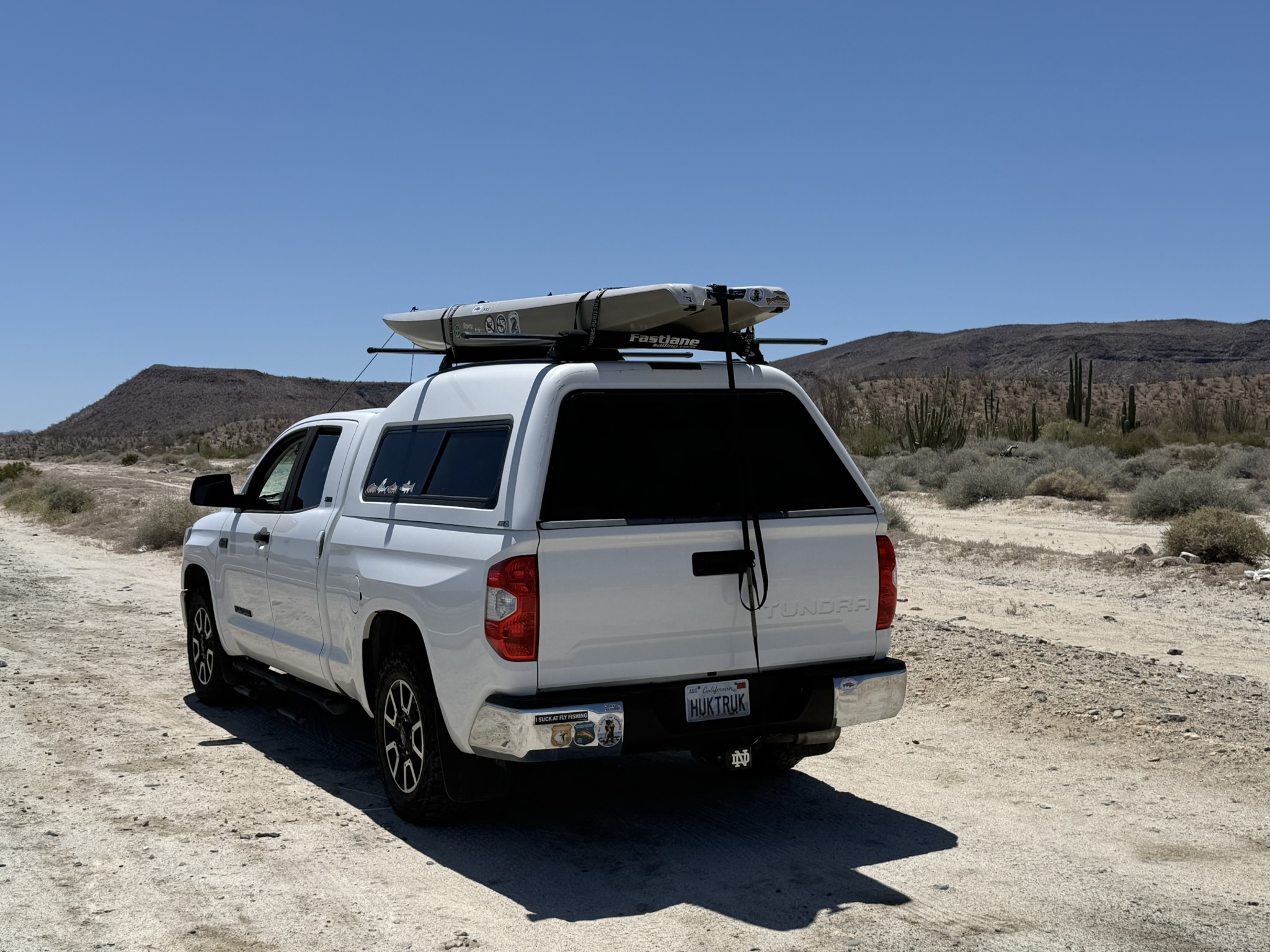
I want all three types of Hobie Kayaks. No one Hobie kayak fits all fly fishing scenarios. But it’s not practical to own all three. Which leads me to the biggest drawback of fly fishing with a kayak and honestly, it’s the “elephant in the room”. Hobie Mirage Kayaks are expensive; especially as compared to a float tube:

  • I-Trek: $2,799 – $2,999 MSRP
  • Lynx: $2,999 MSRP
  • Pro Angler Models: ~$4,599 to ~$5,899

There is a used market for Hobie Mirage kayaks and many people in the club will watch for months on sites like Facebook Marketplace or Craigslist before making a purchase on a used Hobie Mirage kayak. Our local dealer in San Diego for Hobie Kayaks is Fast Lane in Mission Bay. They are a tremendous help. You can find information on all the Hobie fishing kayaks here: https://www.hobie.com/fishing-kayaks/
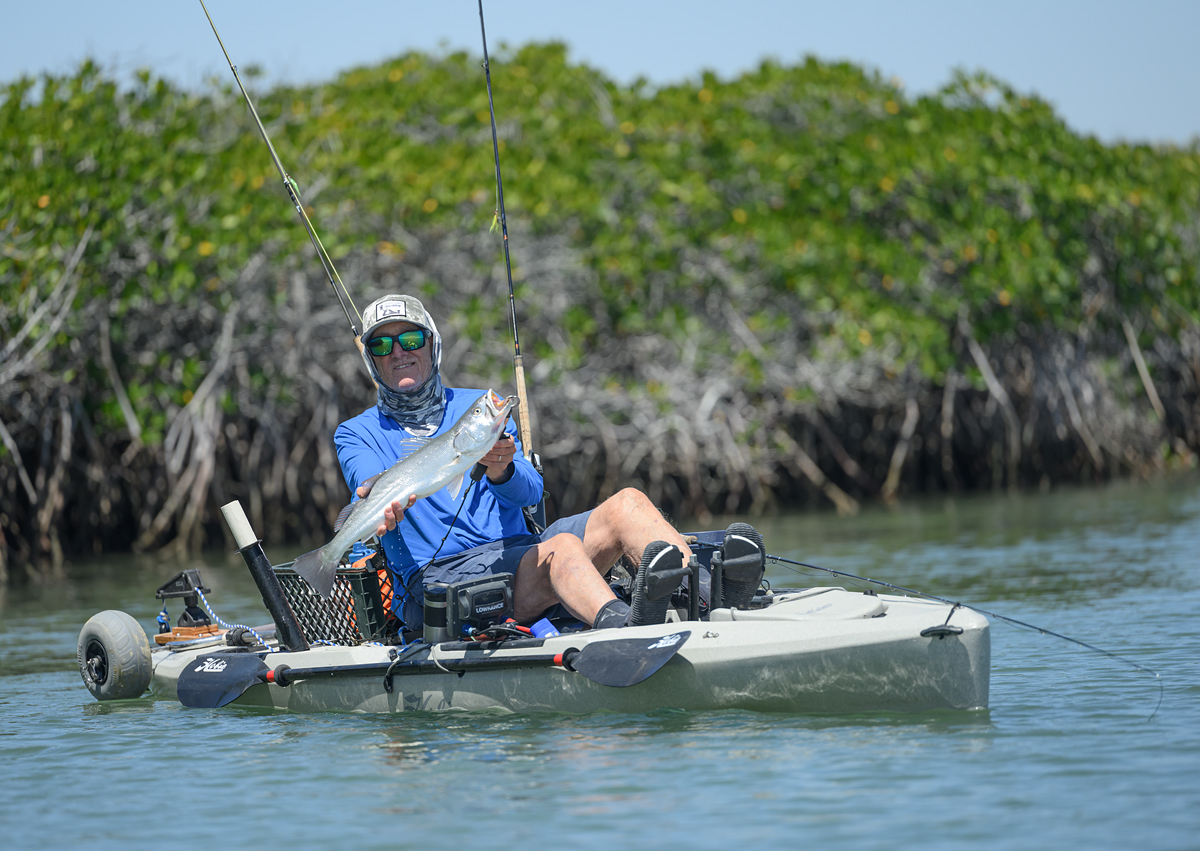
Another interesting contrast between a Hobie Mirage kayak and a float tube is that a float tube is pretty darn easy to fish in. There’s no real learning curve and there’s no real such thing as getting good at float tube navigation. Navigating a Hobie Mirage kayak for fly fishing takes some skill and practice.  The only analogy that comes to mind is mountain biking. There is a huge chasm between a beginner mountain biker and an advanced mountain biker in terms of skill. Fly fishing in a Hobie Mirage kayak is the same.  It’s taken me years of practice to get proficient fly fishing in my Lynx.  Here’s an example you can relate to. I’ll see a fish rising so I’ll speed over to get in casting range of it.  Then I have to slow the kayak down, or even come to a stop so that I can cast to a 6-inch window 40 feet away where the fish rose.  In the mangroves if I get a take, I have to ram it in reverse immediately after the set so that I can yank a big fish out of the roots where the fish is fleeing for shelter.

In the end, both the float tube and the Hobie Mirage kayak offer compelling ways to step off shore and into a more effective relationship with the water and the fish in it.  But for me, and I’m certainly not alone in this belief, effectiveness has tipped the balance.  And the cost of my Hobie Mirage kayak has more than been overcome by the joy it’s brought me.
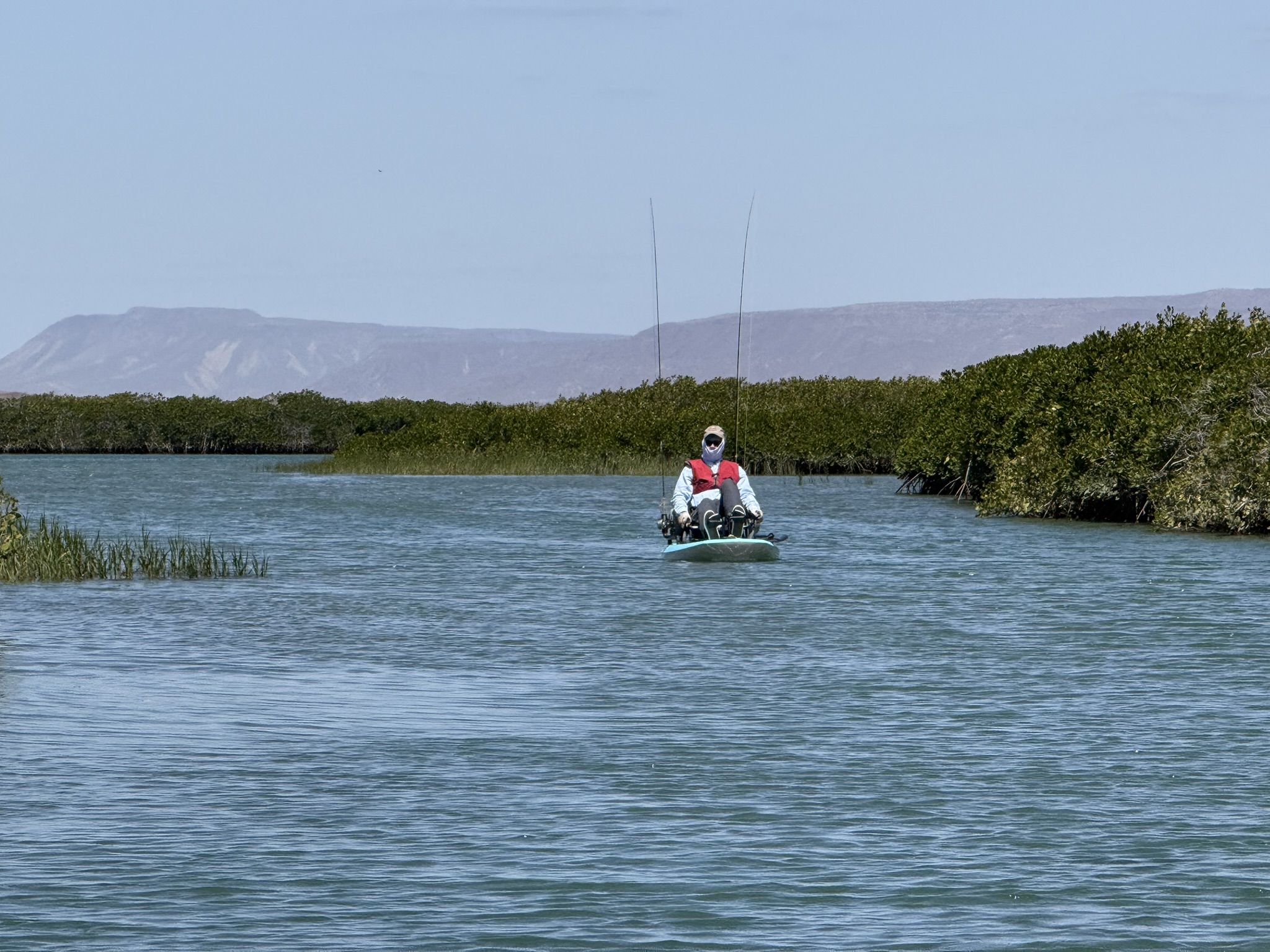
The float tube rewards patience and intimacy, placing a fly angler low and quiet, fully immersed in the moment.  And there are many scenarios where I still use my float tube, like in small water.  Or in Lake Crowley because I don’t want to get two more mpg less at $6 a gallon because of the wind resistance of a kayak on top of my truck.

The Hobie Mirage kayak, however, transforms my intent into results. Its efficiency, control, and range allow me to cover water deliberately, respond to changing conditions, and stay on fish in ways a float tube simply can’t match. What ultimately separates the two isn’t tradition versus technology, but outcomes. When time, weather, or opportunity matter, the Hobie Mirage kayak lets me fish smarter, longer, and with greater purpose. And once you’ve experienced that level of connection and capability, it’s hard not to measure all other platforms against it.

Fly Fishing Carlsbad – Agua Hedionda Lagoon

The Pacific Halibut – evolved both its eyes on one side so it can lay flat on the bottom, disguised, so it can attack prey that swim above it.

I have written about fly fishing in places all over the world so it’s long past time I write about the fly fishing in my own backyard: Carlsbad, CA

Southern California, including Carlsbad, has a long history of saltwater fly fishing.  In the Surf, legendary Fly Fishermen like Al Quatrrocchi, Nick Curcione, Kirk Deeter, Dr. Milton Love, Jim Solomon, Glenn Ueda, Bernard YinLee Baermann, Jeff Solis, and others have written, presented, and taught us how to fish the Socal Surf…especially for the elusive corbina.  In terms of Off-shore John Loo for off shore fly fishing and Conway Bowman always come to mind when fly fishing for Mako’s off the san diego coast.

This article is about fishing Carlsbad’s Agua Hedionda Lagoon from a float tube (or fishing kayak).  It’s funny that I have lived in Carlsbad for 22 years; within a mile of Aqua Hedionda lagoon and I had never fished it until just recently.  Mainly because I’m a trout guy and just don’t have a lot of expertise in the salt water.  Trust me. As I write this I have only fished Hedionda 5 times so I am no expert.  But, because I have had success, I want to share it in case you are interested in C&R fly fishing it.

Firstly, let me elaborate my 2 main inspirations and motivations:

  1. If you are a Socal then you have driven by this lagoon many times and stared at it. It’s just south of the Tamarack exit on the 5 in Carlsbad.  It’s the lagoon with the water skiers on the east side of the 5.  You may have stared at that water and said to yourself, “I wonder if that fishes?”  You may have seen kayak fishermen in there and said, like I did for years, “How in the world did they get in there and I wonder if they are catching fish?”
  2. Recently, Mel Ochs and Kai Schumann did a SDFF club presentation on how to fish the bays of San Diego in a float tube or kayak. It was outstanding.  I learned so much from that presentation.  Let me be honest: I serve as the programs chair for the San Diego Fly Fishers club.  It is my job to ink the speakers for the club presentations and I have signed up some famous ones, both worldwide and from the list above.  So when I roped them into doing this presentation I was a bit selfish in my needs.

The Spotted Bay Bass – affectionately known as “Spotty”

< Side Note: let me put in a plug for joining the San Diego Fly Fishers Club.  It’s only $40 / year and along with all the other benefits, there are 2 presentations by zoom per month during the pandemic; in person once we are finally past it.  If you want to go fly fish the bays with the group of folks from the club, at a minimum, they go every Wednesday and would love to have you and show you the ropes of fly fishing the bays.  >

About Hedionda: The Science and History

Three major highways cross Hedionda: Highway 101 (aka PCH) along the coastline, the train tracks and Interstate 5. These 3 bridges divide the Hedionda into 3 sections:

  • outer bay – just east of the coast highway; closest to the ocean. This section holds the oyster, abalone and white sea bass farms along with carlsbad’s hydro electric power plant and the largest desalination plant in N America.
  • middle bay – separated by the train bridge and highway 5. This section holds the YMCA aquatic park
  • inner bay – east of interstate 5. This section holds California Watersports and numerous homes and condos with docks on the North side and the infamous Carlsbad Strawberry fields on it’s south site.

Hedionda extends 1.7 miles inland and is up to a half mile at its widest point.  All three sections are 8-10 feet deep at their deepest part of the high tide….except for the channel that flows the tide to and from the ocean.  That channel runs the entire length from the ocean to the head of the bay where Hedionda creek feeds it.  The channel is over 30 feet in depth in and around the 3 bridges.  This depth information is important in relation to the fishing.  There is more on tides below in the fishing section of this article.

Hedionda is fed by Agua Hedionda creek to the southeast and Lake Calavera Creek to the Northeast.  Numerous spring creeks feed those two creeks.  But, in reality Carlsbad is a a natural desert so a majority of the water feeding Hedionda is simply lawn sprinkler runoff from well into Oceanside and Vista.  There is a significant amount of fresh water that enters the lagoon at the head of the bay making that “back-bay” brackish for those that want to chase mullet with a fly rod.  When it does rain that creek is a raging dangerous river.

The most amusing part of Agua Hedionda is the name itself: It means “Stinky Water” in Spanish.  The reason is most likely because before a small boat harbor was constructed in middle bay somewhere between 1940 and the 50s, the lagoon was not dredged; it was truly a lagoon. Between the decay of vegetation, the mud and the methane escaping it probably was pretty stinky before dredging provided a constant flush of tidal flow.

From the InterWeb: “The main difference between Bay and Lagoon is that the Bay is a body of water connected to an ocean or lake, formed by an indentation of the shoreline and Lagoon is a shallow body of water separated from larger body of water by a barrier.”

By way of this definition then Agua Hedionda is a bay; not a lagoon.  In fact, it has significant tidal flow just like san diego or mission bay.  There is plenty of great information from the Agua Hedionda Lagoon Foundation here.

The history of Hedionda is pretty sketchy but, in the early half of the 20th century Carlsbad was a mostly an agricultural area….boasting the only place you could get the rare and hard to get exotic fruit: the avocado.  At that time the bay was not used for anything short of the quickest transportation from the farms to the beach: by row boat.  There is some interesting information about the area’s history that the Carlsbad Historical Society turned me onto here.  But, not much on Hedionda itself.

most people who love eating halibut, and have never seen one, probably picture it this way: upside down

How to fish it

The Agua Hedionda Lagoon Foundation says there are 70 species of fish that populate it.  Being that said only a small portion of those fish are predators: the type of fish you would be catching with a fly rod.  And in my limited experience the spotted bay bass dominates that group.  But, I’m a pretty friendly fly fisherman so I did talk to a number of gear guys both on the shore and in kayaks.  And they all gladly provided a tremendous amount of knowledge to me.  In fact, more than once I’d catch a fish, hold it up to a shore fisherman and say, “what the hell is this?”

There are pelagic fish that wonder into Hedionda with the tide.  Of those the most common are white sea bass, rays and halibut.  But sharks and even corbina are caught there too…along with all the usual suspects you see in the surf.  It’s worth nothing that any ocean fishing in a float tube is not for the faint of heart for many reasons.  And being that said I did fish Hedionda in a tube in January of 2021 the day after the beach in front of it was closed down because of a 15 foot great white patrolling the surf.

The author, devilishly handsome, paddling out just after sunrise

Harvesting – I have caught a couple legal halibut and let them go.  It’s partly because of ~30 years of catch and release fly fishing and partly fear of eating from a bay fed by fertilizers and the cancer causing weed killer, round-up.  If I ever do catch a legal white sea bass I’ll have a tough decision to make.  The white sea bass farm is in outer bay and there are escapees.

It’s all about the tides – just like any surf or bay fishing in the san diego area your best success is going to be during an incoming and/or slack tide.  In fact, the only time you will be able to fish close to the train bridge or Highway 5 bridge is during a slack tide.  Not that it was unsafe, but the very first time I fished Hedionda, this trout fisherman was inches from getting pulled from middle bay under the 5 and out into inner bay.  I wasn’t paying attention staring at my fish finder as the tide grabbed me.  The current during that incoming tide was so strong it was like any large river I have fished before.  It took everything I had to paddle my fins away from getting sucked in.  I was huffing and puffing more than I have even done on lake Crowley in the wind.  Again, I was never in danger.  But, if pulled through to the other side I would have had to wait hours for the slack tide to even consider swimming back through again.  and it’s not like I could have gotten out of the water on the other side and carried my tube back.

Along with the tide, there are a number of things that negatively or positively affect your fishing success.  Here are a few:

  • fish finder – My aha moment was from the gang of bay fly fishers from the San Diego Fly Fishers Club. They all use portable fish finders.  There are some super inexpensive ones from the company “Lucky”. You can find them on amazon.com from $40 and up.  After a ton of research, I ended up with the Garmin STRIKER™ Cast GPS.  Its list price is $179.  It’s an amazing little device that deserves its own gear review on this site.  you tether and drag it behind your float tube.  I chose 15 feet (of old floating fly line instead of the cord they included).  since you paddle backwards in a float tube it looks for fish right in the zone you are stripping through (as opposed to directly underneath you like all other fish finders).  I’ll typically cast ~40 feet, let it sink, and strip back.  The device uses your smart phone with the garmin striker app as its UI.  It clearly shows depth and structure and the fish in the water column they are swimming in.  it even counts the number of fish in the schools.  I found myself not blind casting until I saw fish on the finder.  but, in one of my fly fishing sessions, after running out of my allotted spousal time, I quickly paddled right across the bay where the fish finder showed a ghost town.  For the purpose of straightening out my line and tightly winding it back up I hooked up and landed a nice halibut.  It made me late.  Oh well’ she’ll live.  After 31 years of marriage, she knows the “one last cast” thing.  So, there is the lesson learned. you will not be able to see the halibut on the fish finder because they sit flat and still on the bottom, typically waiting for prey to swim by.

    notice my garmin striker cast fish finder in the background

  • time of year – I have only fished in winter and done pretty darn well. But, in talking to the experienced gear guys they have all said it gets pretty nuts in spring and summer so I am looking forward to that.  They also told me the big halibut come in Hedionda to spawn in spring.  Every year I read about 40+ pound halibut being taken in Hedionda by the gear guys.  That sure would be fun on a 6 weight.
  • the moon phases and solunar theory – it’s the hunters and saltwater fisherman that believe in solunar theory. Read about my research and findings on Solunar theory here.   Again I have limited experience fly fishing Hedionda but I did fish on a really good solunar day and “killed”.  Plus I saw a ton of fish on my fish finder.  I also fished on a really bad solunar day and didn’t do so well…and saw very little fish on my fish finder.  Draw conclusions as you may.
  • red tide – whether you believe in climate change or not, the red tides are getting worse and worse each year here in San Diego. I had a bad outing and didn’t see a thing on my fish finder only to find out later there was a little red tide going on.  FYI, there was a huge fish kill in Hedionda last year (summer of 2020) because of a red tide.  Many of the gear guys I talked to were really worried that it ruined the fishing in Hedionda. It has not.

A gear guy on the shore told me this was a white sea bass. But, another fly fisherman in the club told me this is a Corvina (not corbina)

Gear

I use a fast action 6 WT with a sinking line.  In my first outing I used a Rio outbound short line and didn’t do so well.  That outbound line is an intermediate sink line.  Although it was before my Garmin Fish finder I just felt like I wasn’t getting it down to where the fish were.  It’s like my line wasn’t cutting through the current.  So, the next time out I switched to the exact rig I use in Lake Crowley: a heavy sink fully integrated 450 GR integrated heavy sink line. That is a line that really gets down quickly.

For a leader I just use 4-5 feet of straight 12lb flouro.  Flies: I tie my version of a clouser.  I use synthetics, including EP fibers instead of buck tail.  I always tie white on the bottom to imitate the naturals. And I tie in a red patch of flashabou to imitate an injured gill plate.  I tie the top  in chartreuse, blue and grey in sizes 2 and 4.  And they all worked.  I fish two flies: a size 2 in front trailed by 18 inches of more flouro and a size 4.   i really think color does not matter.  but, just like in trout fishing the trailing fly gets most of the hookups.

Here’s an example of a couple beat up size 4 clousers i tied.  beat up from getting chewed by spotties and halibut.  the clouser rides hook up so white is on the bottom.  look closely at the red patch that imitates an injured gill plate.

Epilogue:

This may go without saying, but there is nothing peaceful and serene about fly fishing Hedionda.  This not like fly fishing the Gallatin canyon in montana.  The freeway noise is constant.  And depending on which way the wind is blowing the freeway noise can be downright loud.  In fact i had a trucker honk at me while i battled a halibut right off the 5.  I raised my fist to him in glory.

I know what you are saying, “Where do I park?  Where do I Launch? Where did you catch all your fish in Hedionda?  I did write that part and created detailed maps.  And then I removed it from this article.  Why?  Well, in respect to the handful of gear guys that helped me.  But, honestly, although it’s rare, I recently got a hate mail from a selfish fly fisher that wants his fly fishing location to be his and his alone.  So, consequently, doesn’t want me publishing this type of info on the public interweb.  I am a strong believer in conservation by awareness.  Granted, for every one “hate mail” I get a hundred emails thanking me for info.  Fly fisherman are typically such unselfish, trustable and “giving back” type of people.  But, there are exceptions; people are people.

I’d be happy to share that map, parking and fishing location info with you.  Send me an email from here.  And donate $5 to the Agua Hedionda Lagoon Foundation here while you are at it.