“Why would you make a sport that’s already difficult, more difficult by trying to do it in a kayak?”
That was said to me years ago when I first bought a kayak for fly fishing. I laughed then and it’s still funny now because to a certain extent it’s true.
I love fishing in a float tube. I have over 35 years of experience fishing in a float tube. I “cut my teeth” fly fishing in a float tube in Lake Crowley. A float tube gives you so much more access to water you couldn’t fish by wading. Having access to a float tube gives you access to fly fishing our bays and our lakes here in SoCal where I live.
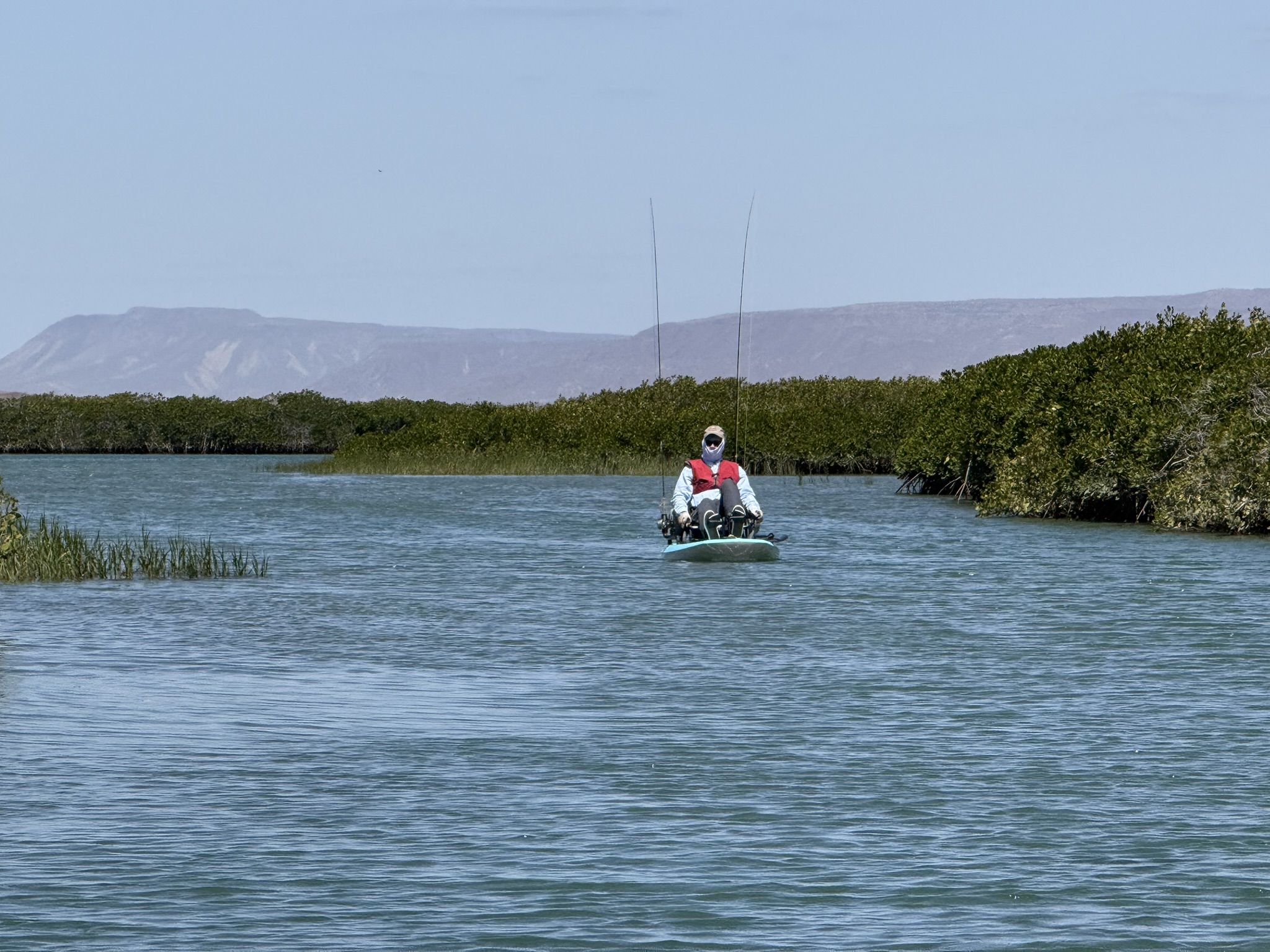
It was San Diego Fly Fishers Club (SDFF) members John Ashley and Kai Schumann who convinced me I needed to buy a kayak for fly fishing. I desperately wanted to go on the club’s annual camping and fly fishing Baja trip. “You can’t fish the mangroves in the Estero in Baja without a kayak.”, they said. Although at the time I was skeptical, purchasing a kayak was one of the best, if not the best, fly fishing decisions I’ve ever made.
me
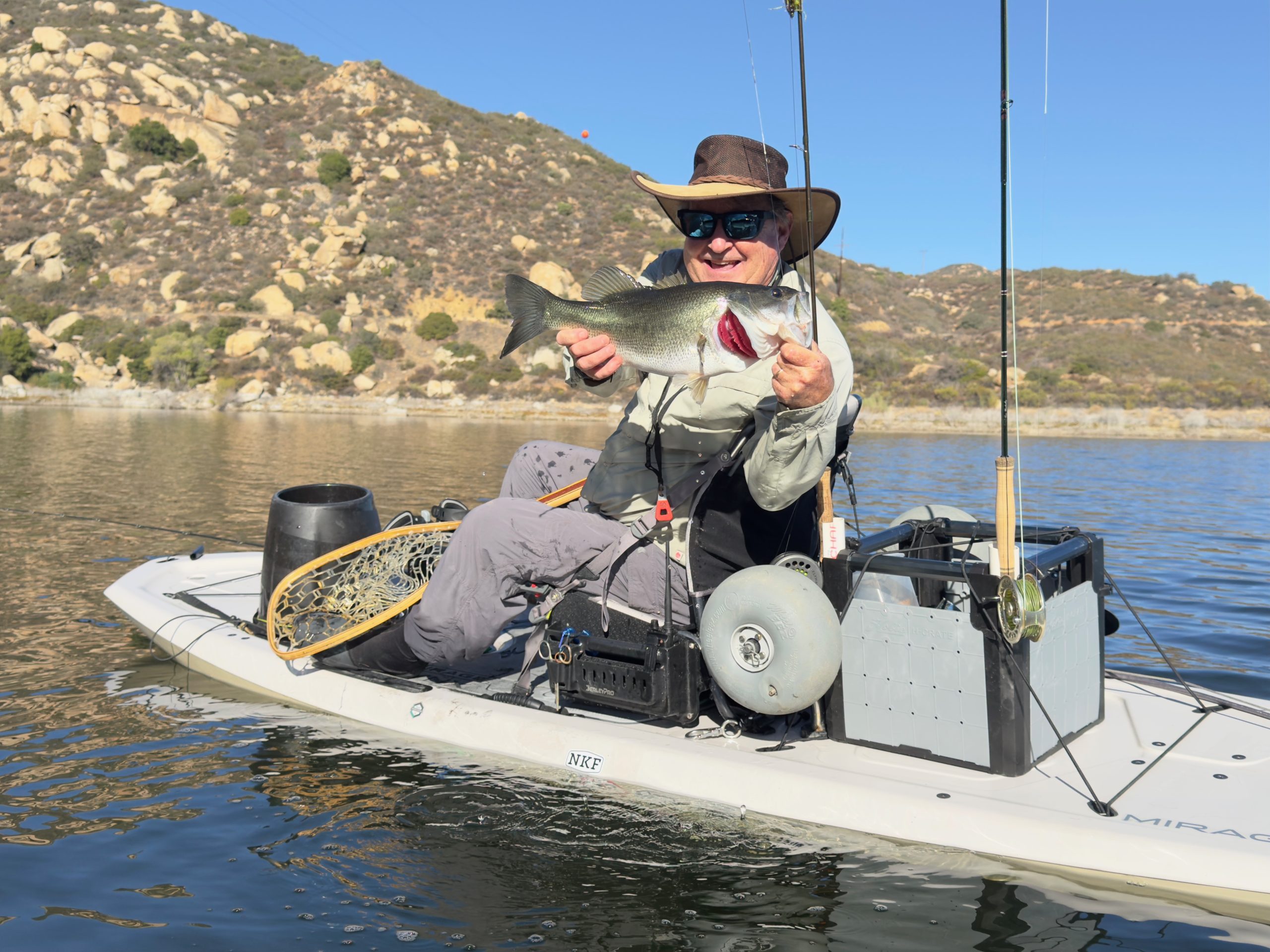
It’s the simple fact, that my kayak gives me so much more access and 10X the range of a float tube. A kayak is lightning compared to a float tube. When it’s calm, I even take my kayak into the open ocean. I can even chase the boils, whether it be the shad in Lake Barrett or in the salt water, and be a lot more agile than a motorized boat. There’s no way you could chase down fish boiling on a float tube. I’ve chased the large mouths tormenting the shad bait balls in Lake Barrett. I’ve chased the white sea bass tormenting the sardines in Agua Hedionda in Carlsbad.
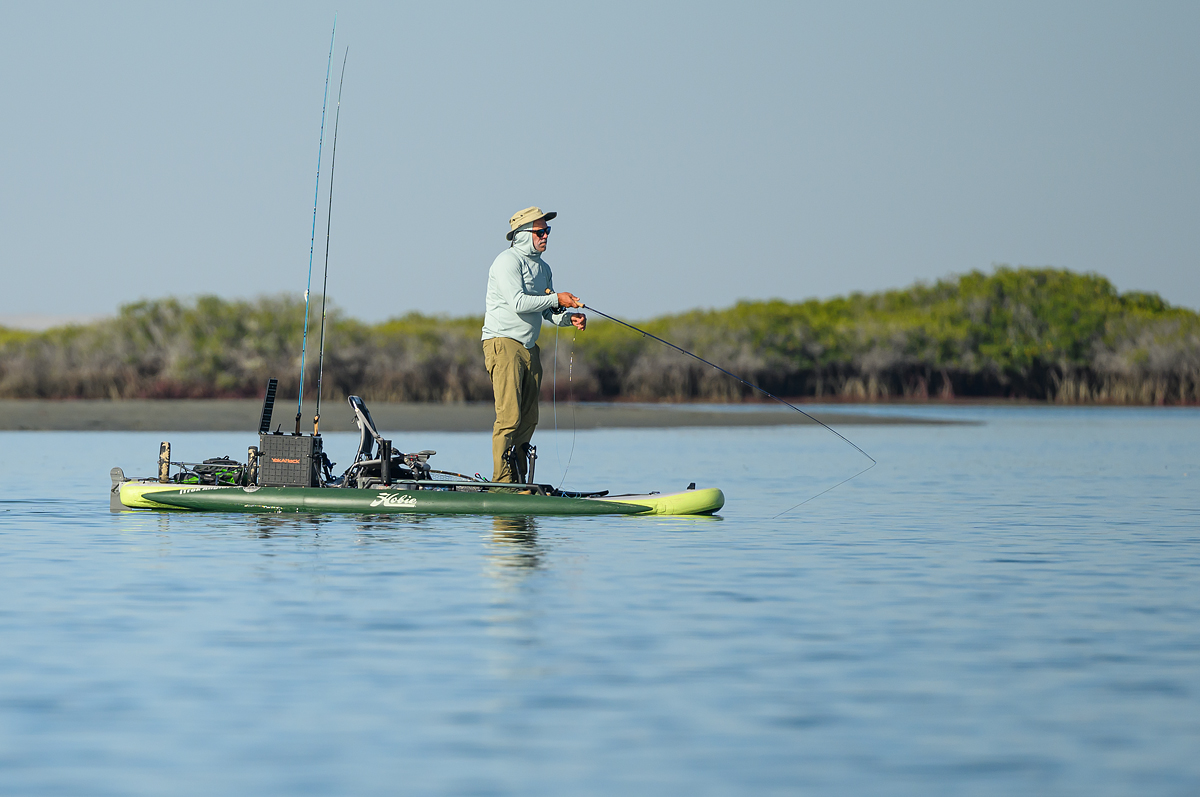
When you think of a kayak, you typically think of paddling with a two bladed oar. That’s not the case with the kayaks we use in the San Diego Fly Fishers Club. The typical kayak of the San Diego Fly Fishers Club is a Hobie Kayak with Mirage Drive. Hobie Mirage Drive give you pedals attached to fins that propels the kayak, allowing you to fly fish “hands-free”. Certain models of the Hobie Mirage Drives we use in the club have forward and reverse and can practically “turn on a dime”. Having reverse and that type of agility is practically necessary for club trips like in the narrow canals of Squaw Lake. And in the mangroves of Estero Coyote in Baja.
A Float Tube pretty much demands that you wear waders and fins. And because of sitting in the water, even though you’re dry, you’re just going to be a lot colder than sitting on top of a kayak. Frequently I can step on my kayak, fish all day then off my kayak, and not even get wet.
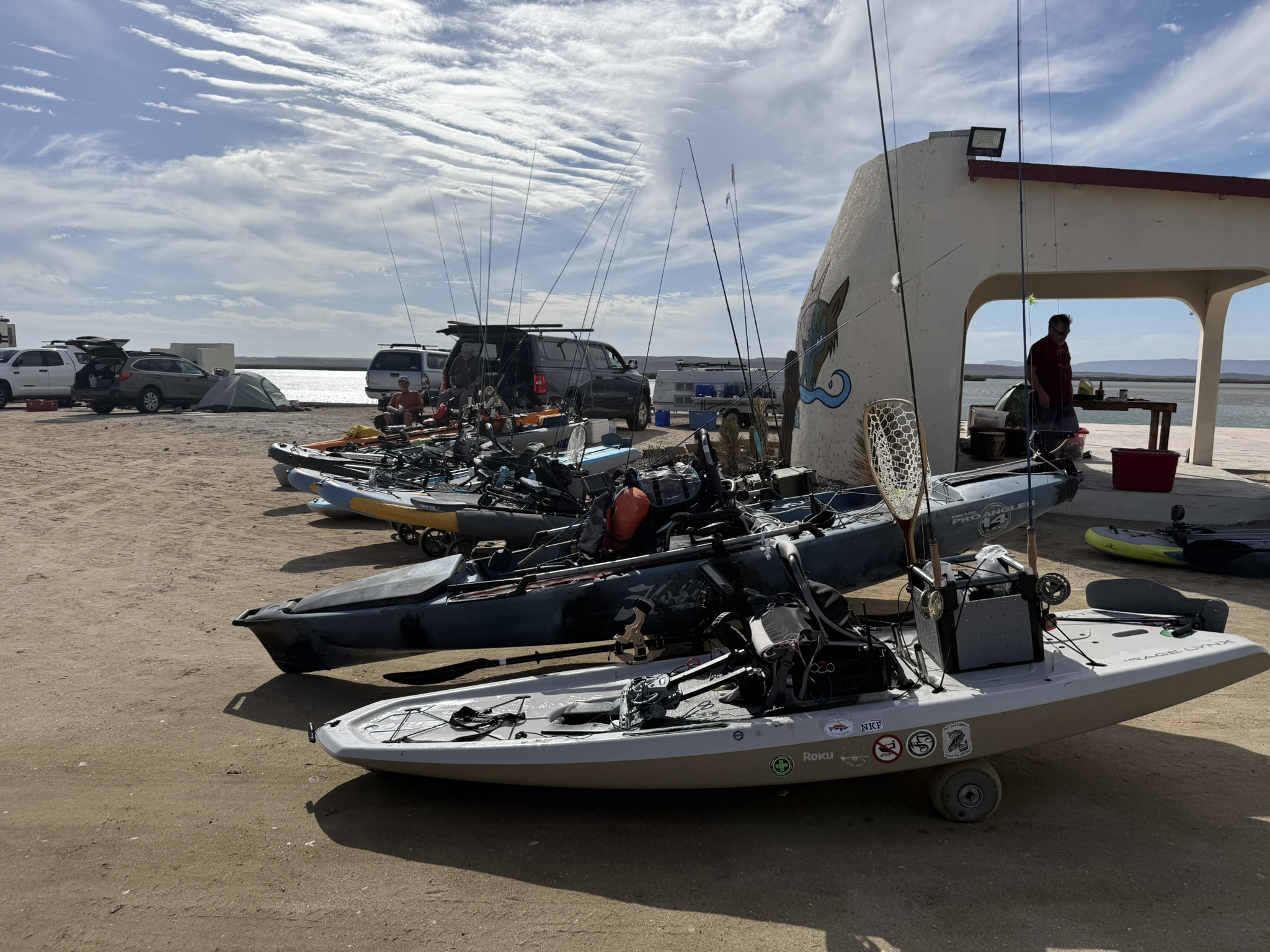
In the SDFF club most people use one of three types of Hobie Mirage kayaks:
- The I-Trek series: I’d say the majority of SDFF club members own an I-Trek because they are an inflatable. Being inflatable makes easily portable, just like a float tube is. It packs up into a ridiculously small footprint so it’s easy to throw in the back of your car. The drawback, of course, is as an inflatable, if you run into something sharp, you’re going to get a puncture. The punctures are easily fixed but it’s a hassle, nonetheless.
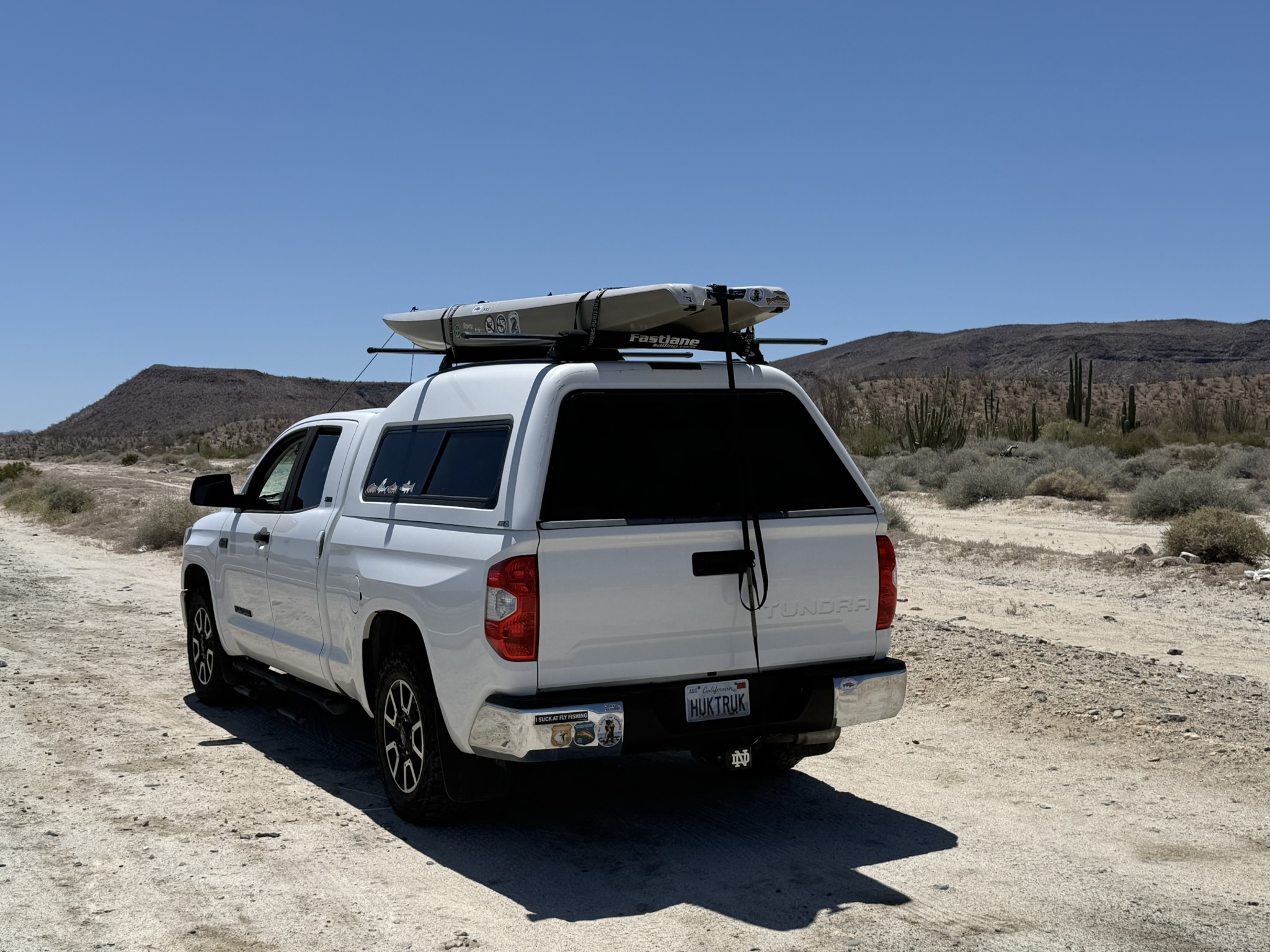
- The Lynx: there’s about a dozen of us in the club that own this model and I’m one of them. I love my Lynx. It’s my pride and joy. My fly fishing life improved so dramatically when I got my Lynx. Unrigged it weighs less than 50 lbs so it’s easy for me to slide it on top of racks on my truck. It’s made of the same materials a stand-up paddle board is made from. It’s lightning quick and stable. I can stand up and walk from bow to stern on it. Its drawback is that because it’s light, it gets blown around pretty good in the wind.
- The Pro Angler: The gold standard for pedal‑driven fishing kayaks. Suitable for the open ocean. The Pro Angler is big and heavy; rugged and durable. A trailer is recommended but you can roof rack them with some effort.
I want all three types of Hobie Kayaks. No one Hobie kayak fits all fly fishing scenarios. But it’s not practical to own all three. Which leads me to the biggest drawback of fly fishing with a kayak and honestly, it’s the “elephant in the room”. Hobie Mirage Kayaks are expensive; especially as compared to a float tube:
- I-Trek: $2,799 – $2,999 MSRP
- Lynx: $2,999 MSRP
- Pro Angler Models: ~$4,599 to ~$5,899
There is a used market for Hobie Mirage kayaks and many people in the club will watch for months on sites like Facebook Marketplace or Craigslist before making a purchase on a used Hobie Mirage kayak. Our local dealer in San Diego for Hobie Kayaks is Fast Lane in Mission Bay. They are a tremendous help. You can find information on all the Hobie fishing kayaks here: https://www.hobie.com/fishing-kayaks/
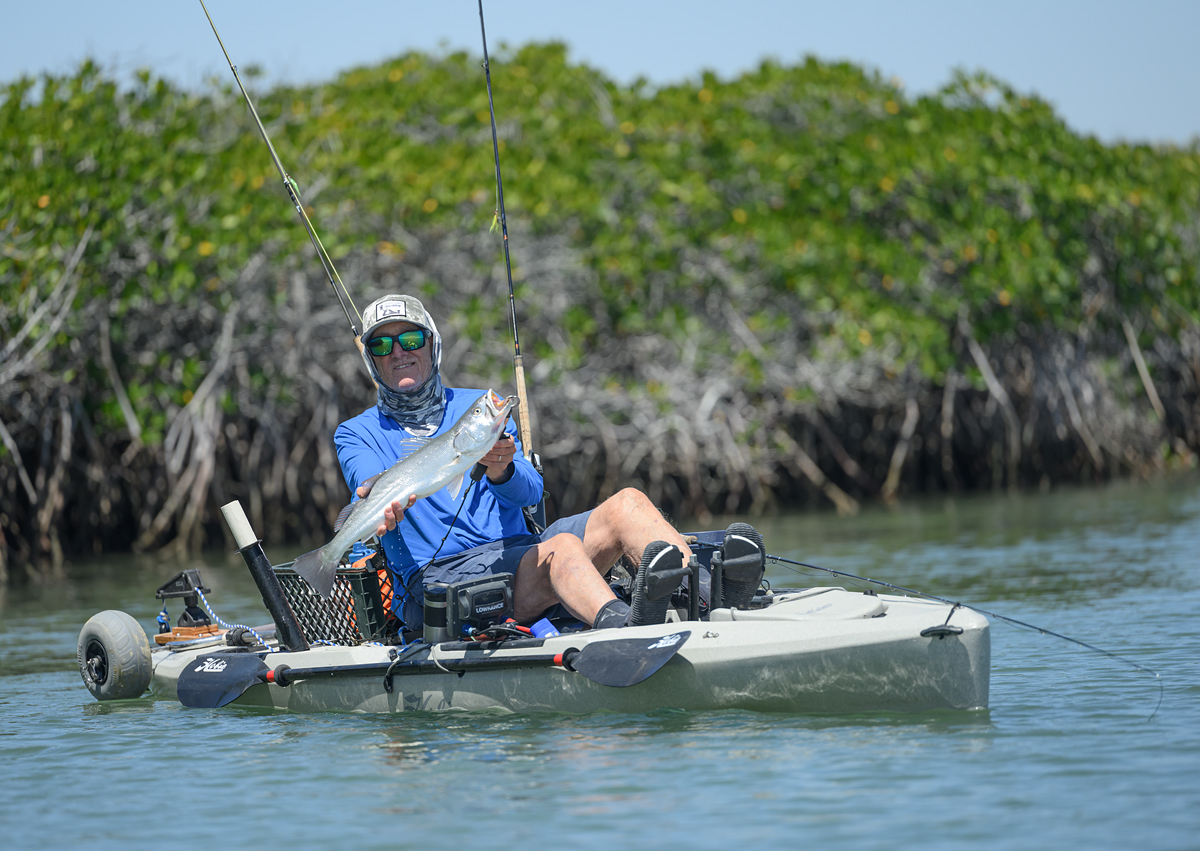
Another interesting contrast between a Hobie Mirage kayak and a float tube is that a float tube is pretty darn easy to fish in. There’s no real learning curve and there’s no real such thing as getting good at float tube navigation. Navigating a Hobie Mirage kayak for fly fishing takes some skill and practice. The only analogy that comes to mind is mountain biking. There is a huge chasm between a beginner mountain biker and an advanced mountain biker in terms of skill. Fly fishing in a Hobie Mirage kayak is the same. It’s taken me years of practice to get proficient fly fishing in my Lynx. Here’s an example you can relate to. I’ll see a fish rising so I’ll speed over to get in casting range of it. Then I have to slow the kayak down, or even come to a stop so that I can cast to a 6-inch window 40 feet away where the fish rose. In the mangroves if I get a take, I have to ram it in reverse immediately after the set so that I can yank a big fish out of the roots where the fish is fleeing for shelter.
In the end, both the float tube and the Hobie Mirage kayak offer compelling ways to step off shore and into a more effective relationship with the water and the fish in it. But for me, and I’m certainly not alone in this belief, effectiveness has tipped the balance. And the cost of my Hobie Mirage kayak has more than been overcome by the joy it’s brought me.
The float tube rewards patience and intimacy, placing a fly angler low and quiet, fully immersed in the moment. And there are many scenarios where I still use my float tube, like in small water. Or in Lake Crowley because I don’t want to get two more mpg less at $6 a gallon because of the wind resistance of a kayak on top of my truck.
The Hobie Mirage kayak, however, transforms my intent into results. Its efficiency, control, and range allow me to cover water deliberately, respond to changing conditions, and stay on fish in ways a float tube simply can’t match. What ultimately separates the two isn’t tradition versus technology, but outcomes. When time, weather, or opportunity matter, the Hobie Mirage kayak lets me fish smarter, longer, and with greater purpose. And once you’ve experienced that level of connection and capability, it’s hard not to measure all other platforms against it.